Guru Accountancy
We help progressive entrepreneurs to set their business ambition and long term direction
We combine technical expertise commercial understanding and practical experience to help businesses stay compliant navigate change and make confident decisions for the future.
Beyond accounting, we act as a strategic partner for your business. Our consultancy services are designed to give you actionable insights, strengthen internal systems, and guide you towards sustainable growth.


We combine accounting expertise, commercial understanding, and technology-driven solutions to help business owners stay compliant, improve performance, and build stronger businesses.




Some Importent Questions and there ansers
This depends on various elements such as how many transactions your company has, how often you like to review management reports, and what compliance requirements your business has. It is ideal to have one of the bookkeeping software. However, in most cases, it is very important that you use one of the bookkeeping software like Xero accounting and QuickBooks.
A company is one form of legal status. There are other legal statuses such as Sole Trading, and Partnership. The main question remains if a company’s legal status is suitable for your business. It depends on various elements. We will help you to decide what legal status is suitable for your business in our consultation phase. Contact us
You must tell HMRC that you are taking on a new employee. You need to submit an application to be a registered employer. Once HMRC approves your application, you will be provided Employer Paye Reference and Account office reference which are used to run payroll. If you are thinking about taking on employees, we can assist you throughout the process.
If you need to complete a tax return/self-assessment, you need to have a Unique Tax Reference(UTR). Check if you need to submit a tax return in the next question.
<p>Check if you need to submit it. The below are the most common reason why you need to complete a tax return: </p> <ul> <li>You are a company director and have income not taxed at source. ( Please note that a company director with income taxed at source and no further tax to pay does not need to submit a tax return. </li> <li>You are getting income from land and property in the UK</li> <li>You are getting taxable foreign income of £300 or more</li> <li>You receive annual income from a trust and settlement</li> <li>Your annual income will exceed £100,000</li> <li>You have untaxed income which not be coded in PAYE</li> <li>You are due to pay High Income Child Benefit as your income for Child benefit proposes is over £50,000 and your partner or you get Child Benefit payment.</li> </ul> <p>Do not worry, we will help to navigate through it. <a href="https://sam.guruaccountancy.co.uk/contact-us"><strong>Contact us</strong></a></p> <p> </p>
<p>Yes, that is right. We can talk to HMRC on behalf of you as an agent. We will tell HMRC that we act as an agent with them and HMRC will send you a letter with an authorisation code and you give the code to us and we use it to authorise us as agents.</p>
<p><span style="color:#000000">According to the Pensions Acts 2008, employers in the UK must put eligible staff into a workplace pension scheme and contribute towards it. This is called automatic enrollment. Regardless of what you do at what level, the day anyone starts working for you, you are an employer. From this date, the automatic duties begin. </span></p> <ol> <li><span style="color:#000000">What are my duties related to Automatic enrollment? </span></li> </ol> <p><span style="color:#000000">From the day one you are an employer, your duties begin. But the duties you need to carry out depending on your particular situation. It needs to be assessed whether you need to contribute to a pension scheme or whether you don’t have to contribute it. How it works!!</span></p> <p><span style="color:#000000">Check if any of the employees works for your meets followings criteria: </span></p> <ul> <li><span style="color:#000000">Aged between 22 and up to state pension age </span></li> <li><span style="color:#000000">And earn more than £833 months(£192 per week)</span></li> </ul> <p><span style="color:#000000">If the criteria are met, you have to provide a pension scheme. </span></p> <p> </p> <p><span style="color:#000000"> But remember you still have other duties :</span></p> <ol> <li><span style="color:#000000">Write your staff</span></li> </ol> <p><span style="color:#000000">It is part of your legal duties to write all your staff individually to explain how automatic enrollment applies to them. You must do this within six weeks after your duties start. </span></p> <ol> <li><span style="color:#000000">Declare your compliance</span></li> </ol> <p><span style="color:#000000">You have a deadline to declare five months after your duties start. </span></p> <p><span style="color:#000000">In the declaration, you tell the regulator how you have met your other duties.</span></p>
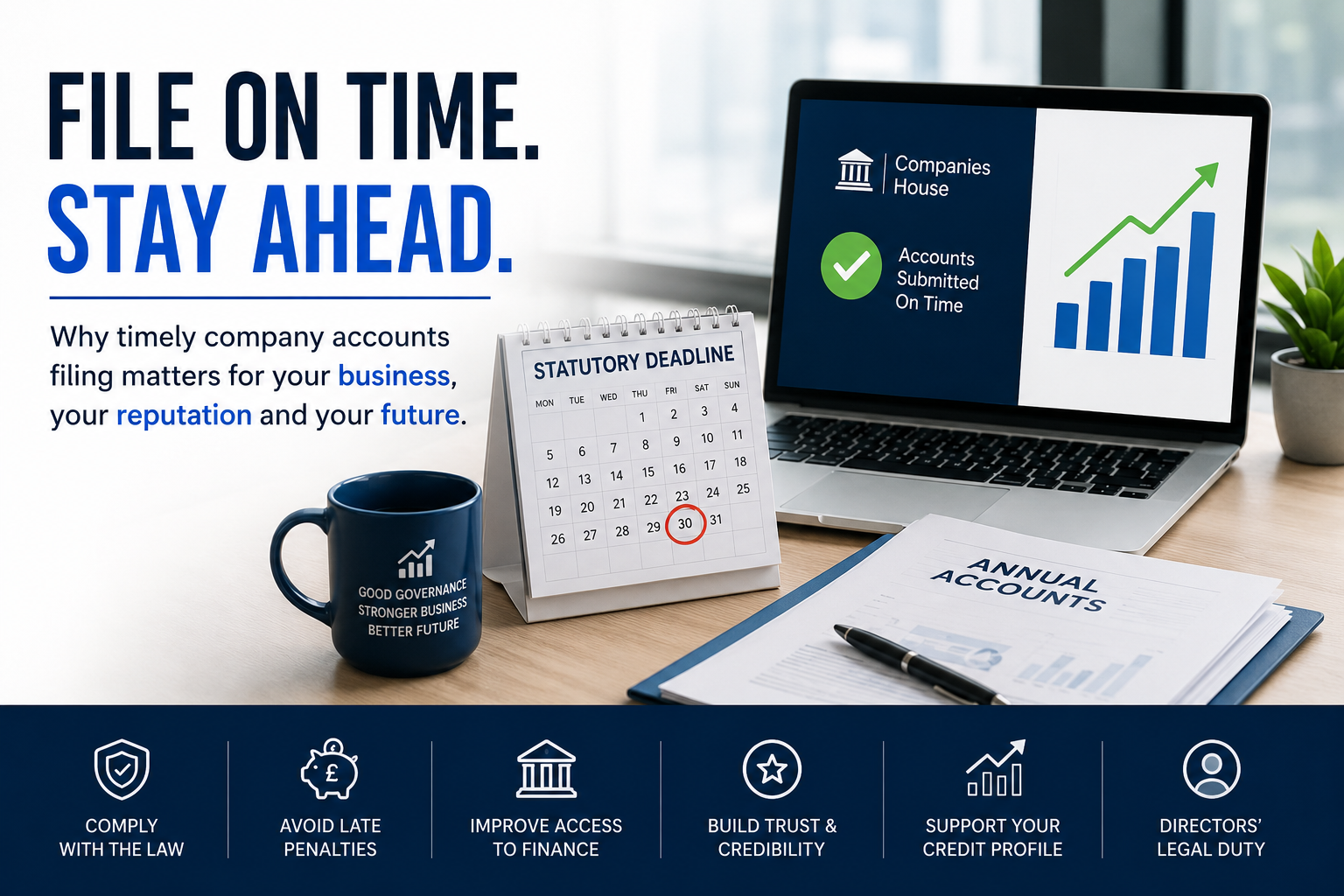
<p style="text-align:center"><span style="color:#000000">Your private ltd company needs to file a Confirmation statement and Statutory(full) accounts with companies house and tax returns with HMRC.</span></p> <table border="1" cellpadding="3" cellspacing="2" style="width:100%"> <tbody> <tr> <td style="text-align:center"><span style="font-size:18px"><span style="color:#000000"><strong>What to do?</strong></span></span></td> <td style="text-align:center"><span style="font-size:18px"><span style="color:#000000"><strong>HMRC or Companies House</strong></span></span></td> <td style="text-align:center"><span style="font-size:18px"><span style="color:#000000"><strong>When(Deadline)</strong></span></span></td> </tr> <tr> <td style="text-align:center"><span style="font-size:18px"><span style="color:#000000">File your first account with Companies House</span></span></td> <td style="text-align:center"><span style="font-size:18px"><span style="color:#000000">Companies house </span></span></td> <td style="text-align:center"><span style="font-size:18px">You have 21 months after the date of incorporation. </span></td> </tr> <tr> <td style="text-align:center"><span style="font-size:18px">File annual accounts with companies house</span></td> <td style="text-align:center"><span style="font-size:18px">Companies house</span></td> <td style="text-align:center"><span style="font-size:18px">You have 9 months after your company’s financial year ends. </span></td> </tr> <tr> <td style="text-align:center"><span style="font-size:18px">Confirmation Statement </span></td> <td style="text-align:center"><span style="font-size:18px">Confirmation statement </span></td> <td style="text-align:center"><span style="font-size:18px">You must file a statement at least once a year, you may file it more often if required.</span></td> </tr> <tr> <td style="text-align:center"><span style="font-size:18px">Pay Corporation Tax if you owe any</span></td> <td style="text-align:center"><span style="font-size:18px">HMRC</span></td> <td style="text-align:center"><span style="font-size:18px">You have 9 months 1 days after your accounting period.</span></td> </tr> <tr> <td style="text-align:center"><span style="font-size:18px">File a Company Tax Return</span></td> <td style="text-align:center"><span style="font-size:18px">HMRC</span></td> <td style="text-align:center"><span style="font-size:18px">12 months after your accounting period for corporation tax ends</span></td> </tr> </tbody> </table> <p> </p> <p> </p> <p> </p>